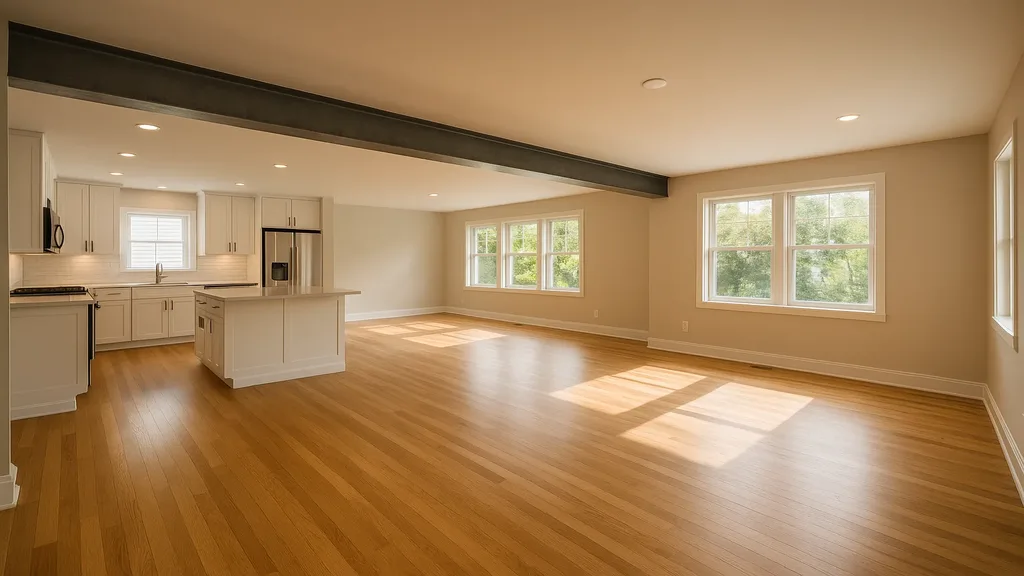
Open-concept living remains one of the most requested renovation features across the Niagara Region. Homeowners see the potential — a connected kitchen, dining, and living space that feels spacious, social, and modern — and want the wall between their kitchen and living room gone.
The desire is understandable. The execution requires careful planning.
Not Every Wall Can Come Down (Safely)
The first question is always: is the wall load-bearing?
A load-bearing wall carries the weight of the structure above it — the floor joists of the second storey, the roof trusses, or both. Removing a load-bearing wall without proper engineering is not a renovation — it is a structural failure waiting to happen.
How to Identify a Load-Bearing Wall
While a structural engineer should always confirm, there are clues:
- Walls running perpendicular to floor joists are more likely load-bearing than walls running parallel
- Walls located near the centre of the house often carry load because floor joists typically span from exterior wall to centre bearing point
- Walls that stack directly above each other on different floors are almost certainly load-bearing
- Exterior walls are always load-bearing
A non-load-bearing partition wall (also called a curtain wall) carries only its own weight. These can be removed relatively simply. But you must verify before demolition, not after.
The Engineered Beam Solution
When a load-bearing wall needs to come down, an engineered beam takes over the structural support. This is not a DIY project — it requires:
- A structural engineer to calculate the beam size, bearing point loads, and connection details
- A building permit from your municipality (load-bearing wall removal always requires a permit in Ontario)
- Temporary shoring to support the structure while the wall is removed and the beam is installed
- Proper bearing posts at each end of the beam, transferring load down through the floor structure to the foundation
The most common beam types for residential open-concept conversions are laminated veneer lumber (LVL) and glulam beams. Steel I-beams are used for longer spans or heavier loads.
Cost Expectations
In the Niagara Region, a straightforward load-bearing wall removal with engineered beam installation typically costs $3,000 to $8,000, depending on the span length and complexity. This includes the engineering assessment, permit, beam material, temporary shoring, installation, and refinishing.
It is money well spent. The alternative — a collapsed ceiling, cracked walls, or sagging floors — costs exponentially more to repair.
What Else Is Hiding in That Wall?
Beyond structural considerations, walls often contain:
- HVAC ducts that serve rooms above or adjacent
- Plumbing stacks (drain lines, vent stacks, water supply)
- Electrical wiring (circuits, junction boxes, switch loops)
- Gas lines (especially walls near kitchen ranges)
Each of these needs to be rerouted before the wall comes down. Ductwork can often be rerouted through the ceiling or floor. Plumbing stacks are more challenging and expensive to relocate. Electrical wiring is usually the simplest to reroute.
At JVR Complete, we open a small inspection hole in the wall before demolition to identify every hidden element. Surprises are expensive — advance knowledge is not.
The Design Considerations
Removing a wall is the easy part. Making the resulting open space feel intentional and designed is the real challenge.
Ceiling Transitions
If the two rooms had different ceiling heights, materials, or textures, you will see an obvious line where the wall used to be. The ceiling needs to be blended seamlessly — new drywall, taped, mudded, and finished to match.
Flooring Continuity
Two rooms often have different flooring. With the wall gone, that transition is now visible and needs to be addressed. Options include running new flooring through the entire space or creating an intentional transition detail.
Defining Zones Without Walls
A fully open space can feel formless. Use these design tools to create definition:
- A kitchen island that serves as a visual boundary between cooking and living zones
- Changes in ceiling treatment (a dropped soffit over the kitchen, coffered ceiling in the dining area)
- Pendant lighting that anchors the dining table location
- Area rugs that define seating groupings
- Consistent colour palette that unifies the space while allowing subtle variation between zones
Is Open Concept Right for Your Home?
Open concept is not universally better. Consider:
- Cooking smells and noise travel freely in open spaces — if you deep-fry regularly or have a loud range hood, the dining and living areas will share that experience
- Visual clutter is always visible — a messy kitchen counter is on display during dinner parties
- Heating and cooling can be more challenging in large open spaces
- Heritage homes may lose period-appropriate room proportions and architectural character
The best open-concept conversions maintain some separation — a half wall, a dropped header, or a change in floor level — that creates flow while preserving definition.
If you are considering an open-concept conversion in your Niagara home, contact JVR Complete for an assessment. Our drywall, framing, and structural team will evaluate the structural situation, identify hidden services, and design an open space that feels intentional, not just demolished.