Every year I see kitchen design trend articles written by people who have never built a kitchen. They pull images from European design shows and declare trends that bear little resemblance to what actual homeowners are choosing and what actual contractors are building.
This is different. These are the trends I am installing right now, in real Niagara kitchens, for real homeowners with real budgets. These are the design directions that have moved from aspirational to actionable in 2026.
Handleless Cabinetry
The biggest shift in kitchen cabinetry over the past two years has been the move toward handle-free designs. Instead of pulls and knobs, drawers and doors open with:
- Push-to-open mechanisms (Tip-On by Blum) — press the door, and it springs open. Press again, and it closes with soft-close dampening.
- Integrated edge pulls — a routed channel along the top or bottom edge of the door that serves as a grip. No visible hardware.
- J-pull profiles — an angled cut at the top of the door that creates a finger grip. Clean lines, no protruding hardware.
Why it is happening now: The warm minimalism movement demands clean, uninterrupted surfaces. Hardware — even beautiful hardware — creates visual interruption. Handleless cabinets create a seamless, furniture-like appearance that aligns with the desire for calm, uncluttered spaces.
Practical note: Push-to-open mechanisms require quality hardware and precise installation. Cheap mechanisms fail within a year. We use Blum hardware exclusively, which carries a lifetime warranty.
Integrated Appliance Panels
Refrigerators, dishwashers, and even range hoods are disappearing behind cabinet-matched panel fronts. When done well, the appliance is virtually invisible — the kitchen reads as a continuous wall of cabinetry with no visual interruption from stainless steel or branded appliance faces.
Panel-ready appliances cost 10-20% more than their standard counterparts, and the custom panels add another $500-$1,500 per appliance. But the design impact is significant — the kitchen looks unified and intentional rather than a collection of separate elements.
Fluted and Reeded Detailing
Fluted wood panels continue to gain momentum, particularly on:
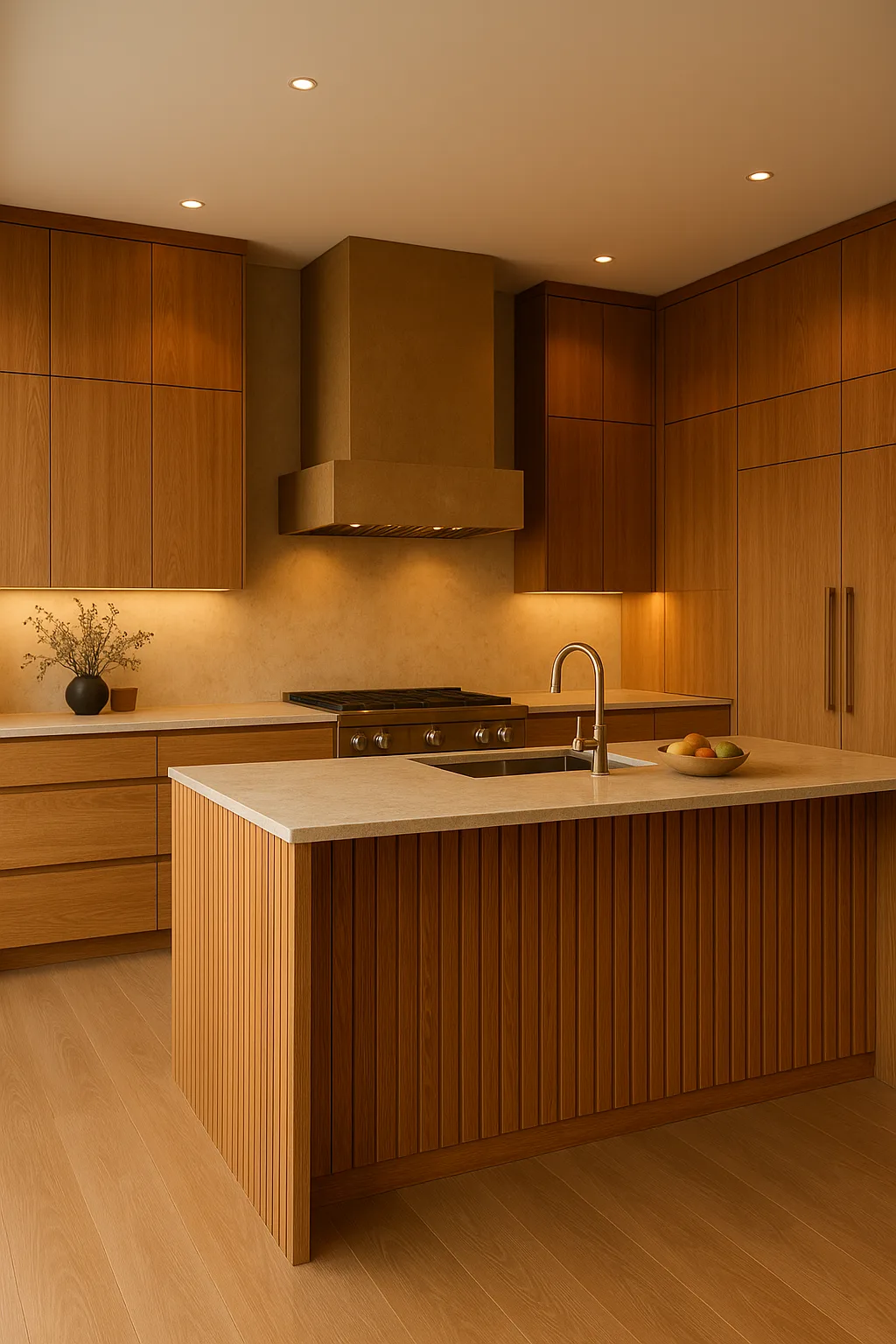
- Kitchen islands — fluted fronts transform the island from a cabinet box into a furniture piece
- Range hood surrounds — vertical fluting on a custom hood creates a dramatic focal point
- End panels — fluted detailing on the exposed ends of cabinet runs adds a custom, finished appearance
The fluting trend has matured from novelty to standard option. Most semi-custom cabinet manufacturers now offer fluted panel inserts, making the look more accessible.
Statement Range Hoods
The range hood has become a primary design feature, not just a ventilation appliance. Custom hood designs in 2026 include:
- Plaster or drywall hoods with a smooth, sculptural finish that blends into the wall
- Wood-clad hoods wrapped in the same material as the cabinetry or island
- Metal hoods in brushed brass, aged copper, or matte black as deliberate contrast elements
- Arch-topped hoods that add a soft, curved detail to an otherwise linear kitchen
The key is proportion: the hood should be sized appropriately for the range and the wall. An undersized hood on a large wall looks timid. An oversized hood in a small kitchen overwhelms.
Warm Countertop Materials
Cool white quartz is being replaced by:
- Warm-veined quartz that mimics Calacatta marble with gold and taupe veining
- Honed natural stone — Travertine, limestone, and soapstone in matte finishes
- Butcher block on islands — particularly walnut and white oak
- Sintered stone (Dekton, Neolith) — an ultra-durable material available in warm tones and natural stone patterns
The direction is clear: homeowners want countertops with warmth, movement, and organic character, not cold, featureless white surfaces.
Warm Mixed Metals
The mixed-metal approach has matured. Rather than a random collection of finishes, 2026 kitchens use a disciplined mixed-metal palette:
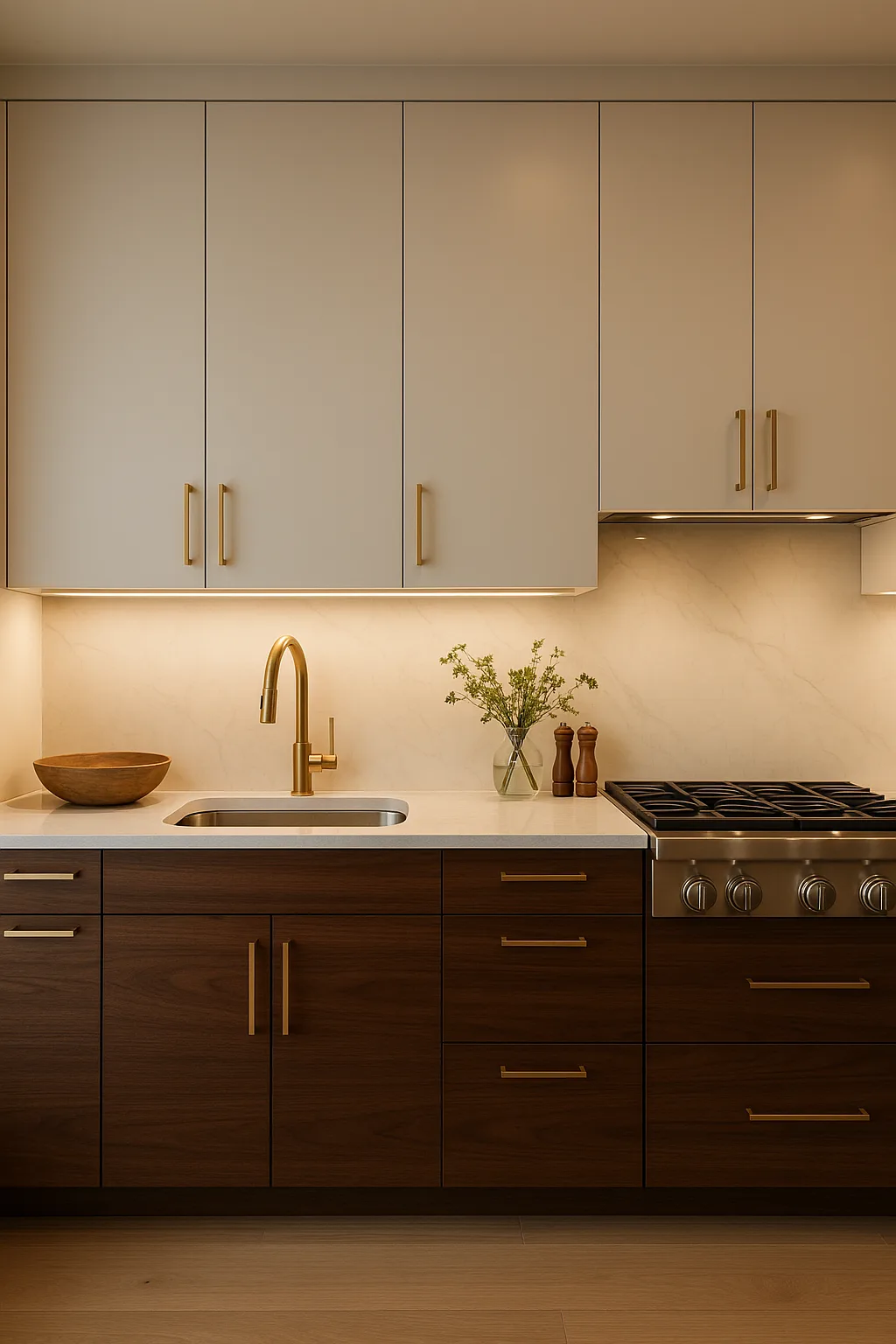
- Primary metal (hardware, faucet): Brushed brass or champagne gold
- Secondary metal (light fixtures, range): Matte black or aged bronze
- Rule: No more than two metal finishes in the same kitchen
The days of matching every metal exactly are over, but the replacement is not chaos — it is intentional contrast within a coordinated palette.
Lighting as Architecture
Kitchen lighting in 2026 is designed as an architectural element, not an afterthought:
- Linear LED channels integrated into cabinet soffits and toe kicks create a floating, layered glow
- Statement pendants over islands serve as sculptural art objects as much as light sources
- Warm colour temperature (2700K-3000K) throughout — the cool, blue-white LED era is over
- Full dimmer control on every circuit allows the kitchen to shift from bright work mode to soft entertainment mode
What We Are Not Building
Equally telling is what has disappeared from our 2026 kitchen projects:
- Cool grey cabinetry — completely absent from our current project pipeline
- Bright white, handleless quartz with no veining or character
- Chrome hardware and fixtures — replaced by warm metals
- Open shelving as the primary upper storage — the trend peaked and clients discovered they prefer cabinet doors
- Industrial elements (exposed ductwork, factory-style lighting) — the warmth movement has moved firmly away from industrial aesthetics
The Takeaway
The 2026 kitchen is warm, tactile, intentional, and calm. It prioritizes natural materials, crafted details, and a sense of organic harmony over the cold precision of the previous decade’s designs.
If you are planning a kitchen renovation in the Niagara Region, contact JVR Complete to discuss how these current directions can shape your project.